Friday, May 21, 2010

Linda Morrell: Blending the Traditional and Digital Processes

A Bit of Background:

When I set off for college in the mid-seventies, I had no idea that photography would be my focus. My skills and potential as an artist were in drawing and painting. However, during my first year at the Rhode Island School of Design, (RISD) which was a foundation year, I chose to take a Photography course as an elective. I loved it. I even loved the smell of the chemicals. In some way, I suppose, the fact that I loved chemistry and science as well as art had something to do with my intrigue with the medium. It was like “controlled magic” when I saw that image emerge from the developer.

While at RISD I had the opportunity to study with photographers such as Harry Callahan and Aaron Siskind and was surrounded by a multitude of talent and energy. I continued on to graduate school at George Washington University in Washington DC and began teaching soon after I graduated.

I have practiced the photographic arts for over twenty-five years as an artist and as an educator. My initial infatuation and continued love of the medium stems from its unique ability to represent the qualities of light and form. Photography’s unique characteristics, unlike any medium that came before, serve as an extension of our vision to record human experiences.
In my imagery I seek to enhance the tactile sense of light and to emphasize the importance of the subject’s color or tone in our awareness of its surface. This sense of light, intrinsic to the medium of photography, becomes integral to the concepts within my imagery.

My approach to the image-making process is most often initiated by a spontaneous response to the world around me. Each composition becomes a personal response both emotionally and psychologically. Thematic concepts become evident and the image –making process moves to a more conceptual level.

Ultimately I want the audience to connect in their own way with my photographic imagery. Their response, for all artists, is the completion of the cycle.

The Inside - Out series.

Having come from a fine arts background I have always seen the exciting possibilities in manipulating a photographic image. Much of my recent work is digital or a combination of traditional and digital processe.

A couple of years ago I started a series of images entitled “Inside-Out”. The idea behind this project began with my exploration of scanograms.

After seeing some images of scanned objects I began experimenting with the flatbed scanner at school. The clarity the scanner provided was amazing. So I started scanning mostly flat objects; some leaves, cloth and tissue paper.

I found myself building a digital library of textures, colors, and forms. Soon I constructed a black box to sit on top of the scanner to allow me to scan three-dimensional objects as well. My first scanograms consisted only of the objects themselves without any camera images.

At the same time I was exploring scanograms I was also playing with a 7.5 mm Canon Lens that I collected years ago. It was not in great shape but created perfectly circular imagery along with all the interesting distortion. When I printed the contact sheet, it looked like some type of eye chart from the ophthalmologist. The image surrounded by black gave a feeling of looking through a peep hole…..from the inside out. Because the lens was not in great shape it produced a somewhat soft, low contrast negative. So I scanned the negatives into the computer and enhanced the contrast and sharpness. 
Some of this imagery worked great as is but I decided to play with the three-dimensional quality by having a piece of the image interact with the circle form. This is where my scanograms came in.

I decided to scan actual objects that might be represented in the circular area of the image. I then pieced the composition together. The softness produced by the quality of the lens together with the incredible sharpness of the scan produced an interesting composite.

As a result this series incorporates the effects of circular observation from both sides of a perceived spatial plane. While my initial approach was a spontaneous, playful response to the circular distortion of the everyday world around me, some of the images quickly began to mimic a voyeuristic view of my subject matter. Hopefully the viewer is enticed into moving inside and out of the picture plane.

Photo Encaustic

A few years ago I went to an exhibition at the Samuel Dorsky Museum at the State University of New Paltz in New York. The exhibition was a selective survey of contemporary works using encaustics and consisted of photo-encaustic, collage, drawing, painting and sculpture. I was immediately drawn to the translucent quality of the wax over the image, the use of color and the textures created by embedded objects within the surface of the art work.

It was not until after I traveled to Italy in 2007, however, that I decided to try working with this medium. I was a Visiting Professor for the University of Georgia’s study abroad program where I lived and taught in Cortona, an ancient Etruscan walled city. Having the opportunity to see actual Greco-Roman encaustic techniques fueled my interest in contemporary encaustic imagery. I decided to incorporate the use of this medium with certain of my photographs because I wanted the surface quality to give the images a sense of tactile reality. Similar to my interest in the quality of scanned objects I am drawn to this technique because of the sense of depth and surface it gives to a photographic image.

The word Encaustic, from the ancient Greek enkaustikos, means to heat or burn. Noted references as far back as 800 B.C. talk about the Greeks using this medium to waterproof the hulls of their ships. Egyptians painted portrait panels on the caskets holding their mummies. Encaustic is made up of beeswax melted with a small amount of resin to impart hardness When pigments were added it was used as a painting medium.

Encaustic is distinctive because of the nature of its application and the unique surface quality attained from the build up of wax layers. The medium must be applied to a surface when melted and almost immediately after it touches a surface it begins to harden. Therefore in order to paint or sculpt images, you must work fast and continually fuse one layer to the next. You do this with the use of a heat source such as a heat gun or a small torch.

The medium must be kept hot on top of some type of heating element such as a griddle or an electric frying pan. R&F Handmade Encaustic Paints in Kingston, NY sells a aluminum palette which provides a sturdy, easy to clean work surface. The paints are warmed by using an electric heating element below the palette. Any brushes and tools that are used also must be kept warm to manipulate the surface texture.

The dammar resin does produce toxic fumes above a certain temperature. Set up should include some type of thermometer to keep the temperature regulated not to exceed 200 degrees. The working space should also have a good ventilation system .

Photo-encaustic uses photographic imagery in combination with the medium. Once an image is adhered to a non-porous surface, it is coated with the encaustic medium. This first layer must then be fused with a heat gun to the mounted image. Careful technique with the heat source will create a smooth base coating. Additional layers with color or textures can be added, however each must be fused to the previous for permanence.

Article by Linda Morrell

Monday, March 15, 2010

Torrey Pines at Sunset ©Bill Evarts

April 2010 Newsletter
Bill Evarts: Showcasing Torrey Pines State Reserve

Self-taught in photography, Bill Evarts focuses on landscapes, deserts and the environment. A native San Diegan, educated in the Classics at Stanford, Evarts spent the first ten years after college in conventional photography as he worked the rounds of weddings, Little League teams, school proms and graduations.
As his work became routine Bill turned to his childhood experiences of traveling the Great Southwest with a father who found it almost impossible to pass up a historical landmark or desert waterhole, no matter how remote or obscure. Bill had already developed considerable expertise with black and white photography, and found increasing satisfaction using color transparency film to capture the broad landscapes and details of his native state with his 4X5 view camera.
In 1984 he took the plunge and decided to leave the madding crowds behind, preferring the solitude of the landscape photographer. His beard and his plaid flannel shirt, he says, seem to be the badges that mark him as a follower or at least an admirer of the Ansel Adams school. His quiet and patient manner make it easy for him to wander off the beaten path, out of sight of the nearest MacDonald’s, Wendy’s or Jack in the Box; far enough that he no longer has to carefully crop in camera to avoid the latest and greatest neon sign. He still backpacks in the Sierra Nevada each year.
Evarts comes from a family tradition of historians and environmental writers. Both his grandfathers and father were nationally prominent authors and naturalists. His sister writes nature themed books for young readers, and his brother publishes award winning books on natural history subjects. For seven years in the 1980’s Evarts worked on a portfolio of photographic work of the Torrey Pines State Reserve, then wrote the text to accompany the striking color photographs in the 1994 volume.
The Torrey Pines State Reserve is home to one of the rarest trees on the planet. First identified by physician-naturalist Charles C. Parry in 1850, the Torrey Pine lives in only two small groves totaling less than 2000 trees. The more famous of the two groves is in the reserve; while a second grove survives on Santa Rosa Island off the coast of California.
Named by Parry for his mentor, Dr. John Torrey, the Pinus torreyana has clusters of five needles on a long slender cone. The trees of the Reserve live on a sandstone bluff high above the beach on the California coastline about ten miles north of the downtown area of San Diego. Because the climate is semi-arid and annual rainfall is less than a foot a year, Torrey Pines in the wild are slow growing and tend to be fairly short.
Parry had been looking for coal deposits rumored to be in the cliffs just south of what was then known as Soledad Valley. Soledad, meaning solitude or alone, was an apt name for a valley well isolated from the tiny city of San Diego which then boasted of only a few thousand inhabitants.
While Parry found no coal, he recognized the unique nature of the tree and began a campaign to preserve it from wood cutters and gatherers. Ultimately successful, Parry was probably one of the original “tree huggers.” In 1899 the City of San Diego established a small park of 369 acres to encompass at least some of the rare trees. Ellen Browning Scripps, a local philanthropist, joined the effort, buying up adjoining properties and protecting additional trees. But it wasn’t until 1959 that the park was finally transferred to the State of California to become the Torrey Pines State Reserve. In 1970 the Reserve reached its present size of approximately 1750 acres.
The Reserve is a fraction of Yosemite’s 1200 square miles, and portions of it abut developed parcels, making its preservation highly unusual in an otherwise crowded piece of extremely valuable land. The small land area, surrounded by some two million people, however, contains one of California’s largest undeveloped wetlands, marred only by the crossing of Old Highway 101 and tracks of trains running between San Diego and Los Angeles. It is bordered to the east by Interstate 5 as it runs north-south from Los Angeles to San Diego, and on the west by the Pacific Ocean as its waves break upon its sandy beaches.
It was within this confined space that Bill Evarts worked his magic as he photographed the Reserve from one end to the other. Often arriving before the sun rose over the Laguna Mountains to the east, and just as often leaving after it dropped below the waves of the Pacific to the west, Evarts found ways to exclude almost every trace of human existence as he photographed from the trails, beaches, ravines and canyons of Torrey Pines. He caught the golden light of a fading day as he photographed the cliffs above the sandy shore, and he captured the glory of clouds from a clearing storm as they boiled into the sky.
He must have left no corner of the Reserve untouched as he found the rare Coastal Agave among the needles of a Torrey Pine, and the pale pastels of the evening light filtered and reflected by the boiling surf.
It’s easy to write about Evarts’ work. He’s masterful in his careful choices and gentle in his words as he describes what he has photographed.
Torrey Pines, Landscape and Legacy was finished long ago. You can still find a copy now and then, but to see more of the photographs from Evarts’ work go to the website of the Ordover Gallery in Solana Beach, California. There you can see more of his work at Torrey Pines, and you can see the many faces of the deserts of Baja California where he continues to photograph.
If you visit the website of Amigos de los Californios you’ll see another side of Bill as he and his wife, Sue, help provide medical care to remote villages high in the Sierra de San Francisco. Years ago Bill and Sue established a non-profit corporation, Amigos de los Californios, with the intent to provide medical, dental and eye care to the people of Santa Marta village and its surrounding ranchos. As you read this newsletter they will be in Baja California del Sur with a team for their annual medical clinic, and it’s all without charge to a people who have no money to pay.

Monday, February 22, 2010

Machu Picchu, photograph by Hiram Bingham, 1911

March 2010 issue - Photographers' Formulary newsletter

Hiram Bingham, Accidental Discoverer of Machu Picchu

The facts are well known. Born in Hawaii, son of a missionary minister, Hiram Bingham dreamed of escape and discovery. He longed to escape the sometimes harsh hand of an overbearing father and the confines of the small Pacific islands, at the beginning of the 20th century still isolated outposts of civilization. He dreamed of exploring and discovering things and places yet unknown.

He chafed under the rigid and hard discipline of his father and as he became a teenager began to plan his escape. There was only one way out then, and that was by sea. The sailing ships that had brought his father and others to the placid islands would carry Bingham away, or so he hoped. He and a friend saved their money to pay their passage to the mainland and on the night before the ship was to sail Bingham slipped out of the house and down to the wharf.

Bingham’s friend thought better of the scheme and backed out. The ship didn’t sail on time and Bingham’s father came to the docks to take his son home. Surprisingly, Hiram was not punished. it may have been one those moments in a boy’s life when a father realizes his son is coming of age and begins to back away to give the boy breathing room.

Hiram stayed in Hawaii to graduate from high school, then went to Yale to study and later to teach the history of South America. Realize that in the early 1900’s South America was a very large unknown quantity, unmapped and unexplored in countless square miles of its mountains and jungles. Little was known of the Incas of the Andes, though there had been occasional explorations in the previous century.

What was known about the Incas of Peru was based mostly on the writings about the Spanish Conquistadores who had conquered the Inca empire in the mid 16th century. Many of those writings were made long after events had taken place, inevitably based on reports gathered by others, and often by writers who had never even been to Peru!

Bingham finished his education at Yale and at a very young age became a member of the faculty. He married well, taking as his bride an heir to the Tiffany fortunes. Hard labor, in other words, was not a necessity in his existence. A healthy bank account and an indulgent wife gave him the freedom to explore, and explore he did.

In 1908 he made his first expedition to Peru. He had done his homework and was familiar with the writings of Spanish historians and religious. He knew a great deal about the Inca empire and its remarkable rise and fall in little over 100 years. He understood the politics of conquest and had read of Juan Pizzaro’s remarkable victory over an overwhelming Inca army in 1532.

Bingham’s 1908 expedition led to no breathtaking discoveries, but it whetted his appetite to return in 1911 for further exploration in the areas reputed to have been the “last stand” of the Incas, and perhaps to contain the ruins of their final bastion against the Spaniards.

Bingham was not the first to visit Machu Picchu. He was not the first to report its existence, nor was he the first to leave his mark on what is widely regarded as the best preserved set of ruins of an ancient civilization in South America.

What sets Bingham apart is that he came to Peru prepared to systematically investigate, map and record what he saw. His expedition was well funded, and replete with resources to assure his success if he could only find the lost city of Vilcabamba, the last political capitol of the Inca’s fading empire.

In July 1911 he hit the jackpot. Bingham had heard about a place called Machu Picchu, known to indigenous mountain people, but because it was only one of many names of ruins to be found and explored it held no special appeal to him, or to any others for that matter.

He and his party had worked their way north and west from the border of Peru and Bolivia at the fabled Lake Titicaca. They had already climbed what they had hoped was the highest peak in South America (they missed by several hundred feet,) and they had crossed the burning coast deserts bordering the Pacific Ocean.

Many ruins touted to be excellent examples of Inca architecture or construction turned out to be duds. The native Quechuan population had little interest in abandoned Inca cities; they were more interested in raising enough potatoes or corn to feed their families and their livestock.

But they did know about the Incas, and they often knew where to find this ruin or that one in the heavily overgrown jungle or on the high mountain tops. Early in July 1911 Bingham spoke with a Quechuan who claimed to know of a mountain redoubt called Machu Picchu. Mentioned nowhere in any writings of the Spanish conquerors, not shown on any maps, and totally ignored by Peruvian scholars in the city of Cuzco less than thirty miles away, Machu Picchu was just sitting there waiting to be discovered.

On July 24 1911 Bingham went for a hike with his local guide, Sr. Melchor Arteaga, and Sergeant Carrasco, a military escort provided by the Peruvian government. They climbed into the mountains and eventually came to the homes of two or three Quechuan families who made their living growing corn and other crops on small plots of land.

Bingham asked the families they knew of any Inca ruins. He was assured that they did. He offered to pay the stunning sum of something like a dollar if someone would lead him to the ruins. The adults stayed by their huts, but sent Bingham off with a young boy who told Bingham that the ruins were nearby.

The little group walked further up the path, around a bend and into the open view of the land below. Bingham was stunned by what he saw. There, hanging on the hillside, was what is now known as the fabled Machu Picchu. The Quechuan families had cleared a small portion of the ruins and had been using the stone walled terraces as growing plots for their meager crops. The remainder of the ruins remained engulfed and entwined in jungle growth.

Bingham photographed, or attempted to photograph the ruins that day. He and Sergeant Carrasco returned to their main camp and Bingham reported his findings to his fellow explorers. Bingham had documented his findings as well as he could in the short time he has been in the ruins, but it was enough to assure him a place in history.

In the days to follow Bingham returned to Machu Picchu to further explore, photograph and describe his discovery. In 1913 his copious notes and photographs became the basis of an entire issue of National Geographic Magazine. Though never trained as an archeologist or as a photographer, Hiram Bingham will always be known as the discoverer of Machu Picchu.

The photographs in this article were taken by Hiram Bingham. With the passage of time they are no longer subject to copyright. But to give credit where credit is due, the work of Hiram Bingham, historian, explorer, discoverer and photographer, has given us what has become known as one of the Seven Wonders of the Modern World.

To read Bingham's words of discovery and to see some photographs of his several expeditions, go to "Rediscover Machu Picchu!". Read a chapter of Bingham's writings about Machu Picchu and see photographs of his expeditions in the highlands of Peru and see more of his photographs here. . . .

For all questions or comments regarding this post, please write to:
Newsletter Editor
Formulary.editor@gmail.com

Tuesday, January 26, 2010

In this Issue

February 2010

•Steinbeck Center Features Soledad Mission Photography
•Product Information and Material Safety Data Sheets now Online
•Call for Entries - 3rd Annual Alternative Processes Photography Contest
•Impossible Project Press Release
•February 2010 Newsletter Specials

Steinbeck Center Features Soledad Mission Photography Steinbeck Center Features Soledad Mission Photography

Many are familiar with the works of John Steinbeck and his tales of the Monterey, and of the Salinas Valley of California. Most of us have read his novels, Tortilla Flats, The Grapes of Wrath, East of Eden, and “Of Mice and Men.” Not all of us, however, are as familiar with the National Steinbeck Center in Salinas, California, or the exhibitions and programs it offers.

In April 2007 more than 30 photographers gathered at one of the smallest of the California mission chain in Soledad California. Located almost fifty miles south of Salinas on the banks of the Salinas River, the mission was established in 1791 by friars of the Franciscan Order of Friars Minor as the thirteenth in the chain of 21 missions..

The mission was built in the middle of the Salinas Valley. It’s a hot and dusty place during the summer and not all that hospitable during the winter. A mission church was built, but in 1828 and 1832 the church was damaged, then destroyed by floods.

In the early 1950’s a small portion of the mission was rebuilt. This includes a small chapel, a kitchen, a classroom and the mission office. While picturesque, it has none of the grandeur of a mission such as Santa Barbara or Carmel.

Because it is small and isolated it is often missed by travelers speeding north and south on nearby Interstate 5. So when Formulary instructor Al Weber did stop by the gift shop he found poorly printed postcards that scarcely portrayed the mission. He offered to have better photographs taken, for free, by his friends. The offer was accepted, the gathering of Al’s photographer friends arranged, and history was in the making.

From the photographs a portfolio was produced. Each participating photographer submitted a single image, and became committed to produce thirty copies to include in the thirty portfolios. Al, his wife, Suzie, and a number of friends in the area of Carmel put the portfolios together, boxed them for mailing and sent them to the participating photographers. Two copies were given to Mission Soledad to use for fund raising and for the mission history and a third was designated as a gift to the National Steinbeck Center in Salinas, California.

One of the photographers, Martin Vargas-Garcia, contacted Curator of Collections & Exhibitions, Deborah Silguero-Stahl, at the National Steinbeck Center, offering prints from the portfolio for a show in the center’s gallery.

In December 2009 the show opened as part of Salinas’ Art Walk. A closing reception, at which the Soledad Mission photographers were the guests of honor, took place on January 8, 2009.

The Steinbeck Center gallery was lined with the twenty five photographs taken almost three years earlier at Mission Soledad. Photographers from near and far gathered to enjoy a rare moment of seeing their work on the walls, and the chance to talk to many of those who had taken other photographs in the exhibit.

As the evening came to a close, Al Weber stepped forward to talk about the remarkable collection of images. He explained how the project had come into being from his visit to the museum gift shop, and the enthusiastic reception he had received when he invited his friends to spend a weekend at the mission.

Then, changing the focus of his remarks from photography to the history of the Salinas Valley, he told of his arrival in Salinas in 1953. What he found then, he said, remains today. A community of farmers who work the land, who work together and form the bedrock of the valley’s rich agricultural society.

Weber described the “Natural grace of the landscape,” as well as the, “Incredible wealth of the agriculture” as difficult to beat for a place to live and work.

Soledad Correctional Facility, aka, prison, probably causes some travelers to bypass the town. But, said Weber, drive down the center of the little town and you find yourself in what could be a “cutout” of every small town anywhere. He described Soledad and the Salinas Valley as a place with real people and recalled the remark of the man who delivers his propane that, “You know you are leaving the Salinas Valley when the people quit waving.”

Weber joked that he lives on the coast in Carmel, an area that balances out the Salinas Valley because, “We get all the nuts,” whereas the people in the Salinas Valley are level-headed and filled with common sense.

Click here to watch Al Weber’s remarks...
http://www.youtube.com/watch?v=3_hcYsmTrbY

Colleen Finegan Bailey, Director of the National Steinbeck Center, followed up on Al’s remarks. Ms. Bailey talked about the hard working and dedicated farmers of the valley, and the sentiment that they are “real people.”

The major thrust of her remarks, however, was reserved for Al Weber as she recognized his many years as a teacher, and his dedication to his purpose. “It’s almost harder to find a great teacher than it is to find a great artist,” Bailey said, and in the short time she had known Weber it quickly became obvious that Weber is a great teacher.

The exhibit was proof of Weber’s abilities as a teacher, she said, and the work of his students, hanging on the walls of the exhibit is of value to the Steinbeck Center and to the people of the Salinas Valley as a record of the valley’s rich culture.

Then, looking forward to the next exhibit of mission photographs, Bailey welcomed the prospect of some fifty photographs of Mission San Miguel again taken by Weber’s friends and former students. That exhibition will feature the second “Mission Portfolio Project,” and will take place in late 2010.

Click here to watch Ms. Bailey’s remarks. . .
http://www.youtube.com/watch?v=6wZDIGmsmYA

The person responsible for the exhibit, Curator of Collections & Exhibitions, Deborah Silguero-Stahl, recognized the importance of the photographers and their images, and the connection they have to the history of the Salinas Valley. Martin Vargas-Garcia brought her photographs of Mission Soledad as a gift to the Steinbeck Center, she said, and asked for the possibility of an exhibit to showcase the works.

As she dug into the photographs she realized that they form a contemporary view of the history of Mission Soledad, and of the Salinas Valley. She decided to hang the show in a way that would allow visitors to experience a visit to the mission by walking around the room. The photographs are important, she said, because they help to tell the “Mission Story.” They record the architecture of the mission, and at the same time record the history of the valley, the mission and the State of California.

The photographs, said Silgueros, allowed her to bring a visitor into the landscape, then into the church. A visitor could see the mission and its artifacts, and gain a perspective of the mission as though they had been in the mission themselves. Missions and churches, she said, have a mystique, and the Soledad Mission photographs help lift the veil of that mystique to give visitors a greater enjoyment and understanding of what they are seeing.

Click here to watch Ms. Silguero’s remarks. . .

http://www.youtube.com/watch?v=6wZDIGmsmYA

What’s next on the list? Al Weber has already been approached by Mission San Antonio de Padua, located in the middle of Fort Hunter-Liggett, a military reservation to the south of Salinas and Soledad. Negotiations are underway for twenty-five photographers to spend a weekend capturing the essence of California’s most secluded mission located in the Valley of the Oaks in the Santa Lucia mountains just off the California coast. It’s a mission that has been described as the only one which might still be recognizable by its founder, Junipero Serra, the Franciscan friar who founded it in 1771 as the third of what would eventually be twenty-one California missions.

We’ll keep our eye on this one, and when the time comes you’ll see what develops.

The entire Mission Soledad portfolio can be viewed here. . . .
http://www.angier-fox.com/09-images/09-soledad_portfolio/index.html

Sunday, July 26, 2009

Stardate 07101445

“It's huge, Dad! It's HUGE!,” Paul told his father by cell phone. Paul and I sat with our noses to the glass at the San Francisco International Airport terminal. We were waiting to board our Air China 747 for our flight to Beijing.

I tried to explain that though we caught our flight at almost three in the afternoon, we would chase the sun at about 600 miles per hour, and the sun would never set for us that day. We would land in Beijing more than 12 hours later and it would still be daylight. In fact, it would only be six in the evening, but on the following day. Not enough that we would never see a night, but we would also lose a day on the calendar as we crossed the International Dateline.

Heady stuff for an eight year old mind to grasp. I still find it hard to figure out almost half a century after my first flight west from San Francisco to Saigon. It works, somehow, but it is confusing.

We landed in Beijing and taxied slowly to the terminal. A disembodied voice advised us to please remain in our seats until the plane had come to a complete stop at the gate, and, “Please wait to be decontaminated.” We wondered what that meant, but because we would be among the last able leave the plane anyway, it caused us no concern.

The plane pulled into its parking spot. The engines wound down to a welcome silence and the front door opened many rows ahead of our seats. Then the Invasion of the Body Snatchers began. A crew of eight or ten men and women dressed in white from head to toe, their faces covered with surgical masks and their eyes covered with plastic goggles, swept around the corner and into the plane. Each person held a small gun in their hand. They would look at each passenger, point the gun at the passenger's forehead, click the trigger and quickly turn away.

I know what it will feel like when alien life finally discovers us on our little planet Earth. This has one of the strangest things I had ever experienced. I watched as the little army made its way down the three aisles of the 747, quickly “shooting” each passenger in the forehead, then turning away to check the result on a small digital readout at the back of the infrared pistol.

They were checking for elevated body temperatures, the first of several screenings for Swine Flu. This was serious business. They spoke to no one, moving back and forth from one side of an aisle to the other, careful not to miss a single passenger.

I took several quick shots with my digital camera because while I was amused at the sight, I still found it just beyond unbelievable. I cautioned Paul under my breath that under no circumstances should he cough or sneeze. This would not be the time to joke about Swine Flu unless we wanted to spend the next seven to ten days locked in a hotel room, courtesy of the Chinese Government.

After the DeCon crew passed us, after the absolute last passenger had been cleared, we were told we could leave our seats. There was the usual struggle of eager beavers ready to climb over seats after twelve hours glued to an increasingly hard piece of plastic covered foam, and the occasional piece of luggage raining down on an unsuspecting victim, and then it was over.

We were out of the plane and into the brand new Beijing International terminal #3, a sweeping building of graceful and Olympic proportions. We pulled our luggage cart along, jumped aboard the first of three long moving sidewalks on the route from Flight 986 parking gate to the baggage claim area. It was almost half a mile before we reached the second infrared screening.

Now the temperature sensors were mounted on poles high above us, like surveillance cameras in a 7-11 store waiting to catch a robber in the act. Another masked Swine Flu bandit waved us on, urging us to hurry along and not to dawdle.

At Immigration we were shepherded into lines of “non-Foreigners” and “International travelers.” Friendly place without a single friendly face, every one hidden by a surgical mask covering the face from below the eyes to below the chin.

Past Immigration we boarded a small electric train to take us from Terminal 3 to the baggage claim area. Every three minutes the train runs in a straight line between Terminal 3 and the Customs area. Passengers enter through wide sliding doors at one end of the rails and leave by equally wide doors on the opposite side after a silent, swift Disney “E” ticket ride.

Then began the wait and the search for our bags among those of almost 400 fellow travelers. No different from any smaller domestic flights, but fraught with greater possibility by a factor of 10 that our bags would somehow disappear during the endless flight across the Pacific.

Paul was calm and collected the entire time. What a great little traveler. His eyes were as big as dinner plates as the DeCon Crew came through, but he said nothing. He found our bags as they shot up and out of the baggage chute onto the revolving stainless steel belt like Willy Wonka and the Great Glass Elevator..

We passed Customs without a second glance from the officials, even though I tried to declare some small items of commercial value. Outside the doors a crowd waited for us, straining against white nylon ropes. Our guide, Lydia, held high a small cardboard sign with my name. She saw the recognition in my face and smiled broadly. We had arrived.

Another hour later we pulled into the driveway of the Marriott Courtyard Beijing. Lydia had not stopped her monologue nor slowed to take a single breath during the entire trip as she described this attraction over here or that one over there. She was like an Encyclopedia Britannica salesman at the door, trying to sell us tours if not books of Beijing.

We were ready for a nap. Our long day's journey into night over, we looked forward to checking in, taking a quick swim in the hotel pool and falling asleep between cool sheets in the Beijing heat.

Not to be. The efficient reservation clerk assured us that there was no room for us, and no room at the inn. Every room was taken and most assuredly there was no room waiting for Mr. Anthony from San Diego, California, USA. “What do you mean there's no room! I not only reserved the room nearly five months before, but I had paid for it in full!''

I was ready for battle as the night manager came out of his office far across the lobby. “When did you make this reservation? Who made it for you? We have no rooms,. There is nothing we can do for you.”

Nothing encouraging about that. He agreed to call “Travelbound,” the company responsible for making the reservation. But it was Saturday night in Beijing and I thought he didn't have a chance, Chinaman or not, of finding anyone in the office.

To my surprise he was able to contact someone from Travelbound. Then, for the next 45 minutes he argued with whoever was on the other end of the line, fast and furious, always in Chinese, and never once looking at me. I was a non-person trying to slide under the trip wire and invade his space. He was as efficient and cold as the DeCon Crew.

Then something broke. He seemed embarrassed as he said that he would try to find us something, not to worry. All rooms were taken, but perhaps he could find something. I thought, “Why not put us in the Penthouse?”

It was better than that. He led us to Room 815, where a maintenance worker slid past as we dragged our luggage to the door. No problem; the drain in the sink was disconnected. The shower didn't work. The phone had no dial tone. And the electronic key would not unlock the door.

Minutes were ticking into hours as I imagined myself under a hot shower getting ready for sleep. The manager offered to escort Paul to the swimming pool for a quick swim before the pool closed at 10 pm, and to bring him back. I agreed. Paul went off happily for his reward for waiting patiently through what seemed to be a Beijing version of Waiting for Godot. I stayed in the room because all my cameras and equipment were too valuable to leave unwatched, and if I left, the electronic key would not work and we would not be able to get back into the room.

Paul was delivered back to me safe and sound. He beamed as he described the pool and the great hot shower. I steamed at the thought of the “C” note I was paying for our room. The manager was abject with his apologies promising us a better room our next night. I wondered, but finally our day was over and we could sleep. Day was done, gone the sun, and we would rest.


Day Two- Interviewing Chen Changfen


Stardate 071209.0441

Night passed far too quickly, yet it was never ending. In our less than glorious surroundings we fell into a deep sleep, hoping to revive soon enough for me to make final preparations for my interview of Chen Changfen. With no familiar visual clues other than a brightening sky to tell us the time, and as yet unsure of the correct number of hours to convert California time to local time, we guessed that when we woke it was time to get up.

It was, in one sense. We were awake, and with adrenalin already pumping over what needed to be done there was no going back to sleep. Almost two days' beard scratched at my throat. As one used to shaving twice a day I felt like a hairy wolf ready to gnaw on on the leg of unsuspecting game.

The sink trap had been disconnected. We had been given a small waste basket with instructions on how to position it under the sink before running water. I pushed it into place, ran a few ounces and watched as my modern day catch basin began to fill.

Shaving always feels good. It feels even better when you know you are mowing down a crop of whiskers as big as a field of winter wheat. It took less than two minutes to finish the job, then to admire my handiwork with a quick run of my fingers along a now smooth-skinned throat. I was good to go for another day.

Paul roused slowly. Used to at least 10 hours of what he calls ''Good Sleep,'' he couldn't figure out whether he should get up or dive back under the covers. We sat on the ledge of the window overlooking the street and looked down into the darkness of a 24 hour short order restaurant across the street. A sign in Chinese characters told us little, except a small sunburst on one side, the numbers ''24'' in the middle and a half moon, its crescent split by a star, told us it was open day and night.

This would be a test. Because of the confusion surrounding our arrival we had not had any dinner. In exchange for our less than palatial surroundings we would receive a free breakfast, American style. We were hungry.

The restaurant is on the second floor. To be expected as visitors to another country, few locals speak English, and fewer still feel comfortable in its twists and turns. At the top of the escalator a sign pointed to the Pakistani group breakfast or the Indian group breakfast. I asked the young man at the reception desk where we should sit down. He rustled through his stack of papers and pointed to any table in the completely empty dining room.

We sat down, expecting an eager waiter to rush to the sides of his first customers. Like Mexico, everyone has a job. Across the room a sous chef cracked eggs into a small skillet for scrambled eggs. Toast lent its browning flavors. We would eat soon.

Not quite. ''What is your room number,'' a second young man asked. ''815,'' I told him, expecting a menu in return. No, we were in the wrong dining room. Ours was down the hall to the left, I slipped my backpack over my shoulders, grabbed the handle of our storeboughten luggage carrier and started down the hall.

It smelled good, really good. We walked past a buffet of trays of hot food covered with stainless steel on one side, plates of fresh fruit on the other. Rounding the corner we found breakfast rolls, toast and fresh bread beside brewing pots of hot coffee.

This room, not yet filled, had customers from England, India, Pakistan and Japan for starters. A table of obvious Americans sat next to us. Paul wanted to know how I knew where they came from so we talked about each group's style of dress, their hair, their accents, and even their way of walking.

The Pakistani women, for example, wore elaborate head gear, covered with scarves of various colors. Their walk was a peculiar swaying motion, not the rapid footsteps of an American teenager.

The table of Americans seemed to me to be from either of the coasts. To impress Paul I asked one the men where they came from, suggesting that we suspected they were from SoCal. Wrong. They were from Georgia. From the coast, yes, but not the west coast. Two of their women were from neither coast, but from Colorado instead. So much for my Sherlock Holmes deductions.

Paul ate heartily. Two boiled eggs, toast, watermelon and orange juice would keep him from starving. I laid out my rules for eating. No rules except that he not go hungry. Eat whatever you want, but don't complain that there is not enough food of the ''right'' kind. It didn't seem to be a problem.

Our meal finished, we wandered into the street to explore our new territory before our ride arrived at 9 o'clock. We walked past stores still closed, trying to find one that would sell batteries for a red laser pointer. I had brought it along for a presentation on July 15. Paul, fascinated by its razor sharp beam, quickly adopted it as ''my laser,'' pointing it here, then there before its ruby colored beam faded with the dying batteries.

Sunday, August 17, 2008

September 2008 Newsletter - Ready for Download!


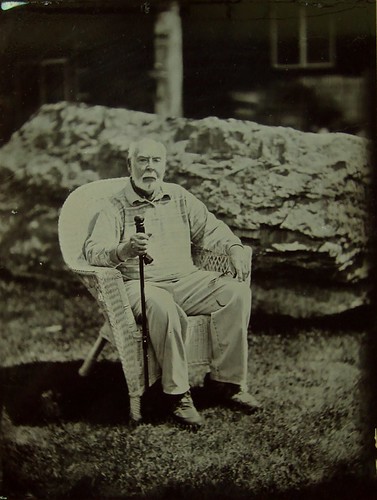
Matt Callow is a photographer with one foot in the Old and the other in the New World. Born in England, he is a transplant to Ysiplanti, Michigan near Ann Arbor. His range of interests in Photography is broad, with extensive work in pinhole photography, Holga toy cameras, Lith Printing, and now Tintype, Glass Negative, Ambrotype and all processes using the Wet Plate Collodion technology. 

Read about Matt, and as you go through the article click on any of the thumbnail images to see a larger version. Remember, all BLUE type acts as active links to additional information and further websites. 

Don't miss a trip to Matt's extensive collection of images on MattCallow.com, and on Flickr.com. You'll enjoy your visit!

Finally, take advantage of the September Specials for online purchase of Alt Processes chemistry.

To download the newsletter, press here. . . .

Or copy and paste this URL into your browser: http://www.photoformulary.com/images/2008Newsletters%20folder/September2008NL.pdf


Tuesday, June 17, 2008

Photograph by Christopher Nolan, ©2008

The July issue of the Photographers' Formulary Newsletter is ready for download.

Chris Nolan
has never developed a roll of film or made a print in a darkroom, but he's an excellent photographer. Read about Chris' trips to Lunenburg, Nova Scotia, and his photographs in the UNESCO World Heritage Site of Lunenburg. Read about his 10 year project as he documented his mother's struggle with Alzheimer's Disease.

Take a careful look at three workshops coming up soon. Dan Burkholder, Kerik Kouklis and Jerry Spagnoli each do very different work, but they are all pros. There's still time to sign up.

Three July Specials are out there for the taking. Don't pass them up.

To download the newsletter, press here. . .

Or copy and paste this URL into your browser:

We hope you enjoy the newsletter. If you should decide you no longer want to receive it, send an email to: Formulary@Blackfoot.net and your name will be removed from our email mailing list.

Thank you,

Anthony Mournian